“Somewhere, something incredible is waiting to be known”
Carl Sagan
Curriculum
Y7
Year 7 scientists start their journey by learning the basics of Biology, Chemistry and Physics. In Biology this consists of Cells and reproduction. In Chemistry this consists of particles and reactions. In Physics this consists of Energy, Forces and Space.
Students use complex equipment such as microscopes, Bunsen burners and energy models to investigate science.
All of year 7 have the opportunity to go to the science museum in London.
Y8
Year 8 scientists continue to develop their scientific understanding in more complex ideas such as photosynthesis, the rock cycle, electricity and waves.
Year 7 and 8 start with a series of lessons exploring how to be good scientists by making careful measurements and considering what data can and cannot tell us.
Year 7 and 8 have the opportunity to go to science club every week to learn and experiment beyond the curriculum. This includes opportunities such as squid dissection and controlled explosions.
Y9
In year 9 students start our GCSE programme after a condensed series of lessons looking at data analysis, variables and graphing data.
Students start their GCSE programme by looking at fundamental concepts in more detail such as Cells, Photosynthesis, particles, energy and atomic bonding.
Students have the opportunity to earn a discovery CREST award during British Science week by engaging in a week long independent investigation of their choice.
Y10
In year 10 students continue to work through increasingly complex areas of the curriculum including ecology, disease, chemistry of the atmosphere and radioactivity.
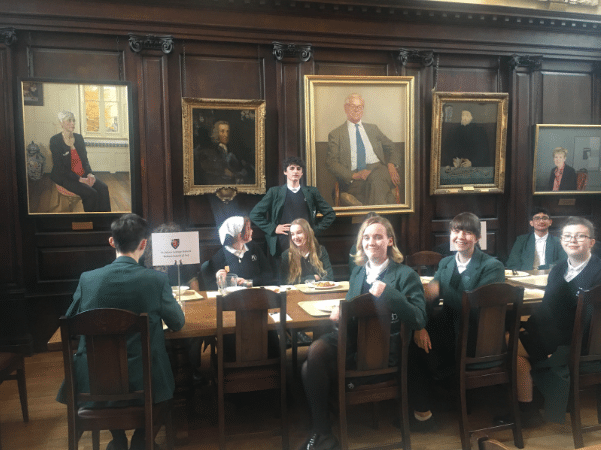
We take a group of gifted scientists to Oxford University for the day to see their natural sciences department and experience a day at university.
Y11
In year 11 students conclude the curriculum by learning about internal conditions in humans, waves, using resources and organic chemistry before structured revision lessons prepare them for their GCSEs.
Students are welcome to attend tiered revision sessions after school to further support their GCSE attainment.
We use cookies to ensure that we give you the best experience on our website. If you continue to use this site we will assume that you are happy with it.Ok