E: pharding@bohuntworthing.com
Key Stage 3 students at BSW study a range of challenge based projects that develop their skills in designing, making and problem solving. At Key Stage 3 we call this STEM.
During their STEM lessons, students use a range of materials including wood, metal, plastic, food, textiles and electronics. The skills they develop build on their past achievements and become progressively more complex as students’ abilities and confidence increase. By the end of KS3, students should have experienced a wide range of tasks and should be capable of working independently within the school’s workshops. Regardless of their future choices, a good grounding in STEM will help students become creative thinkers, who are capable of applying knowledge and understanding to develop practical solutions to new and unfamiliar situations.
Students opting to develop their STEM skills at KS4 (GCSE) can take one of two options: Design and Technology, or Hospitality and Catering.
Starting in Year 9, GCSE design and technology students will begin their studies with an intense course of practical skills development, including CAD/CAM. This is so that they have a diverse pallet of tools and techniques that they can choose from, when developing their design and making proposals. Over the next two years, students carry out design and make tasks that encourage them to move towards sophisticated, commercially viable, thinking. This culminates in the undertaking of a major project for GCSE. The major project, referred to as the NEA (Non Examined Assessment) counts for half of their overall mark at GCSE. This will be based on a choice of three broad based design contexts – which are released by the exam board (Eduqas) in early June of year 10. The project will consist of approximately 20, A3, pages of design work and a manufactured article.
The other half of the GCSE grade comes from a two hour exam, which is sat at the end of the course in year 11. To prepare students for this, one lesson per fortnight is given to studying the theory that underpins the subject. Students will make notes, discuss concepts and carry out short and long answer practice questions. Success in this subject will result in students being awarded a grade 9 – 1 in GCSE design and technology, which will be useful to them on many future career paths.
WJEC Level 1/2 Vocational Awards in Hospitality and Catering enable learners to gain knowledge, understanding and skills relating to a specific vocational sector. In addition to development sector specific knowledge and understanding, these qualifications also support learners to develop the essential employability skills that are valued by employers, further and higher education.
The hospitality and catering sector includes all businesses that provide food, beverages, and/or accommodation services. This includes restaurants, hotels, pubs and bars. It also includes airlines, tourist attractions, hospitals and sports venues; businesses where hospitality and catering is not their primary service but is increasingly important to their success. According to the British Hospitality Association, hospitality and catering is Britain’s fourth largest industry and accounts for around 10% of the total workforce. Since 2010, over 25% of all new jobs have been within the hospitality and catering sector with the majority of new roles falling within the 18-24 age group, according to a report by People 1st.
The WJEC Level 1/2 Vocational Award in Hospitality and Catering is made up of two mandatory units:
Learners must complete both units.
This structure has been designed to develop in learners the knowledge and understanding related to a range of hospitality and catering providers; how they operate and what they have to take into account to be successful. There is the opportunity to learn about issues related to nutrition and food safety and how they affect successful hospitality and catering operations. In this qualification, learners will also have the opportunity to develop some food preparation and cooking skills as well as transferable skills of problem solving, organisation and time management, planning and communication.
Through the two units, learners will gain an overview of the hospitality and catering industry and the type of job roles that may be available to assist them in making choices about progression.
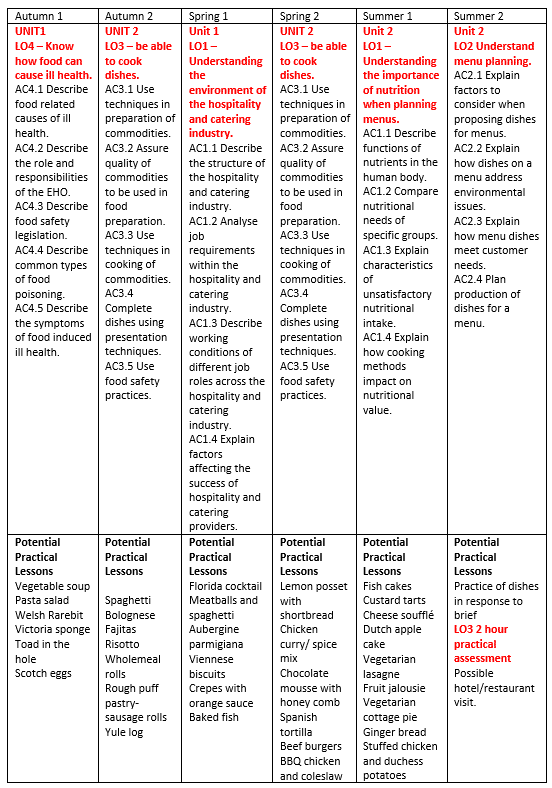
Year 9
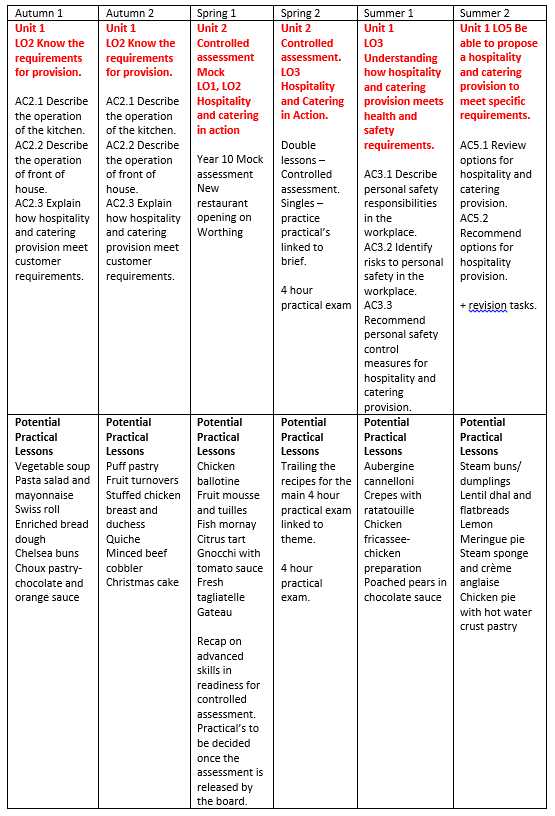
Year 10
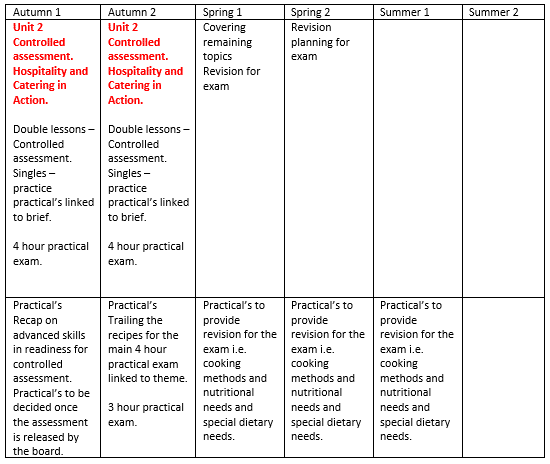
Year 11
Double Nomination
Read More
Double Nomination
Read More
Double Nomination
Read More
Double Nomination
Read More
Double Nomination
Read More
Double Nomination
Read More
Double Nomination
Read More
Double Nomination
Read More
Double Nomination
Read More
Double Nomination
Read More